
OUR PRODUCTS
Naryo A Multichain Event Listener
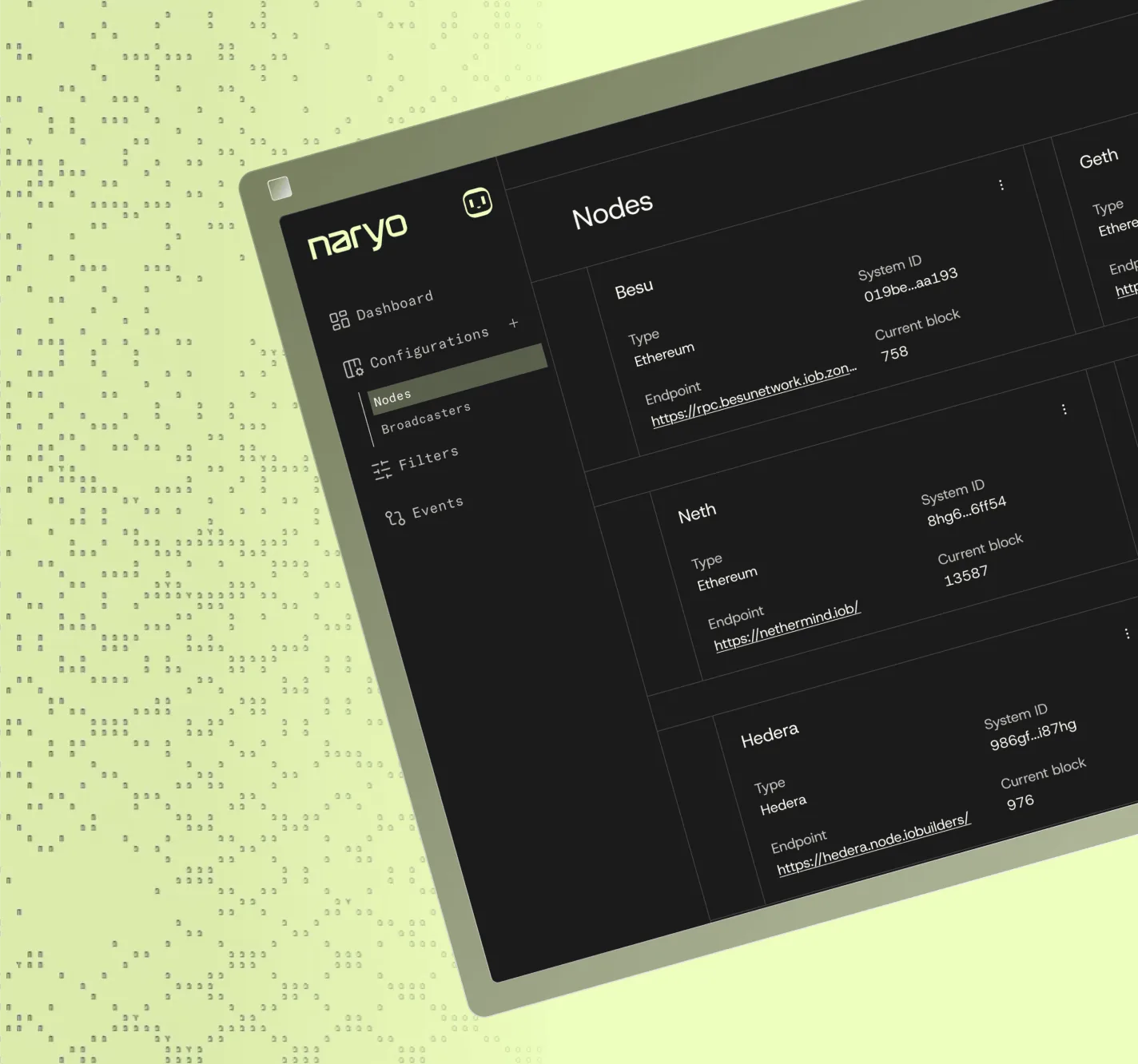
Naryo handles events emitted by DLT networks. It catches events from multiple networks and broadcasts them to multiple destinations, like databases, queues or HTTP endpoints.
NARYO
Why Naryo?
Every DLT project faces the same recurring infrastructure challenges
Time-consuming event handling
Developers spend too much time building and debugging blockchain event listeners.
Low-value engineering work
Event processing is complex but adds little value to end users.
Duplicated effort across blockchains
The same logic must be rebuilt for every network and protocol.
Hard to build reliable real-time systems
Ensuring events are delivered correctly and on time is error-prone.
Naryo
Keep your team focused on what matters
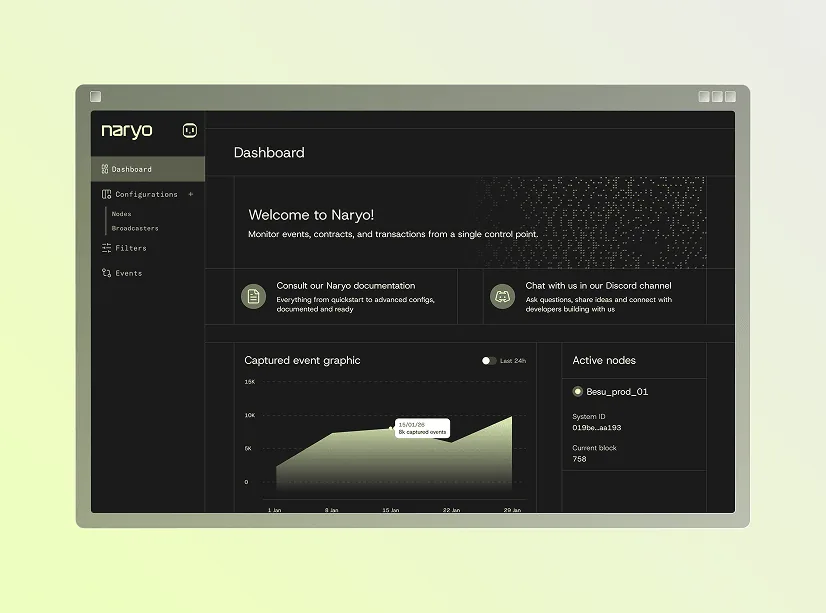
Naryo reduces complexity and accelerates time to market
Start managing events in minutes without reinventing the wheel.
Simplify your architecture by using Naryo for all your networks, including private ones.
Supports Smart Contracts, transactions and blocks events.
Self-hosted and open source. No third party dependencies.
Dead-simple, easy configuration and deployment.
Reliable and scalable. Your Dapp won't miss events regardless of volume.
Multichain. Support EVM and Hiero networks, and more in the future.
Versatile. Manage event filters dynamically through a simple API.
USE CASES
Real-world usage
Tokenization platform
Naryo catches all the events emitted by the Smart Contracts of digital assets (funds, stock, bonds and others) deployed in a private Besu network. When new assets are issued and new contracts are deployed, the filters in Naryo are updated in real time to observe the new contracts, without manual intervention.
Privacy-enabled networks
In a private Besu network with support for EEA-compliant private transactions, Naryo was extended through a plugin, to catch events emitted by private Smart Contracts. The same instance of Naryo was also used to handle public events emitted by public contracts on that same network.
Multichain products
Naryo is deployed as a microservice that sits between the core backend of a multichain tokenization application, and multiple EVM networks and the Hedera public network. When new networks must be supported, the configuration in Naryo is updated to connect to the new nodes and start filtering new events, without altering the code or architecture of the product.
Public networks
Naryo is connected to public and consortium networks, such as Base, Palm, and Polygon. The access to the L1s and L2s mainnets is through RPC providers, which are natively supported by Naryo without needing to update its codebase. Naryo also handled large volumes of activities, including NFTs airdrops on public networks.
Case studies
Real projects, real impact
Beyond the technology
Are you interested?